Showing posts with label Fairy Thorn. Show all posts

Saturday, 5 May 2018

Small Rituals at Bealtaine.


Flowers left on the fairy thorn.

It has been a long, hard winter. 
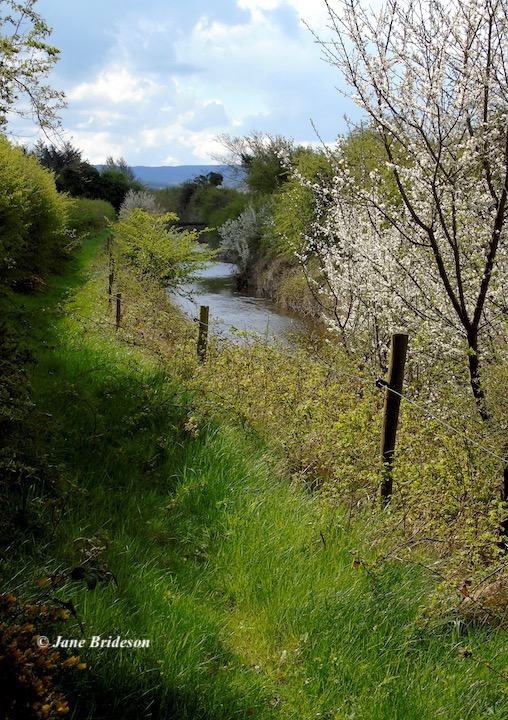
The greening of the land was slow this year but a walk along the river showed blossoming blackthorn
and blue hills released from snow.


Further afield Knocknaman, THE HILL OF THE WOMEN was decked in new growth.


Cnoc na mBan, Knocknaman, Co. Offaly, site of ancient hilltop fires at Bealtaine.


In the past I’ve celebrated Bealtaine with friends, in circles and woods at bonfires and sacred sites.
These days I quietly acknowledge the changing year around my home with small rituals, 
visiting the special places in the local landscape.

May Eve, Oíche Bealtaine, brought a gentle warmth as I decorated the MAY BUSH besides my door to welcome the summer with flowers.  


Slips of Mountain Ash protected the house from unwanted attentions of those who roam on this night.


As the evening deepened I left butter on a fairy path for the Good Neighbours


and milk by the old stone.


During the days that followed there were offerings at the river,
 on whitethorn 


and water.


 And flowers to greet the Good People at the places where they gather.


Decorated fallen thorn by the fairy path.


On the path to the fairy mound at SHEEAN


Tonight, on the old date for Bealtaine, the traditional fires will be lit upon the Hill Of Uisneach 
and my own small bonfire will join with others to welcome another summer.

***

All offerings left on trees are removed at the end of my Bealtaine devotions.


Sunday, 28 May 2017

Whitethorn ~ on the threshold of the Otherworld.


The month of May sees a procession of whitethorn stretching their long white fingers across the green land. 


They stand in the liminal places, between land and water,


beside sacred wells.


They guard ancient sites,


Oweynagat, “Cave of the Cats”, Co. Roscommon, home of the Morrigan.


Grange Stone Circle, Co. Limerick.


And gathering points where the Good People meet.


Distant whitethorn on the local Fairy Path where the Daoine Sídhe are said to gather. 


They trail across forgotten pathways


The path to Sheean. Link to read more: SHEEAN

and carry healing spells.


The Rag Tree at Killeigh, Co. Offaly. Link to read more: RAG TREE 


Standing between this world and the Otherworld the whitethorn, An Sceach Gheal, ‘bright, shining thorn’, is steeped in folklore and regarded with respect for fear of supernatural retribution. 


Felling a lone thorn brings bad luck and today many farmers continue to work around them.


Injury or even death could also befall anyone who damaged or cut down a lone bush. 
The close relationship between tree and Good People was acknowledged across the island. 


Some thorns were believed to have almost human attributes. 


In Co. Cork it was understood that a stick of whitethorn would have a temper of its’ own if used in anger and elsewhere blood was believed to flow from a lone bush if felled.

The kinship between thorn and Daoine Sídhe was occasionally utilised by people.
In Co. Laois it was once customary to sprinkle sprigs of whitethorn with holy water before planting them in fields in the belief that banishing the connection to the Otherworld would discourage the Good People from taking the crops.


Within old church yards thorns are left in place although they are often pruned 
to reflect Christian symbolism.


This bond was understood to be of service to cattle too.
Farmers would hang the afterbirth of a premature calf on a whitethorn believing that the bush would help it to survive and in some areas a sprig from a fairy thorn was hung in the milk parlour to encourage cows to produce creamier milk. 


The May Bush decorated skeletal remains of whitethorn and ivy.
Link to read more: MAY BUSH 


On May Eve when the bush was decorated there were differing views on the use of whitethorn for this purpose. 

In some areas it was acceptable and in others, using a branch of thorn was considered unlucky.

Throughout the country however, it was believed that bringing blossom into the house would shortly be followed by illness and death.


Whitethorn blossom exudes a scent that many find unpleasant and it has been found that the chemical trimethylamine, which is formed when animal tissues decay, is also present in the blossom. 


Unbaptised infants who had died and were denied internment in consecrated ground, were buried in the ‘sacred space’ beneath lone thorns, especially if they stood within fairy forts.


Lone thorn on Rath Coffey used as an infants' grave.
Link to read more: Cillín


Others mark age-old stopping places from hearth to grave.

Whitethorn standing between farm yard and road. 
It was customary for bearers to rest the coffin at the foot of this bush and local lore states 
that the thorn must not be removed. 


By the end of Lughnasadh the Whitethorn has become the Hawthorn,
limbs laden with red haws. 


And as the year progresses the tree reveals her true nature.


Thorn on the Burren - image © eyeem.


Living an average of 400 years, with some reaching 700, they become twisted and gnarled, claws sharp and fingers bent with age.


Thorns on the Burren coast.


A procession of bent forms reminiscent of hags, ridden by the wind.


'Wind-blown Trees' by Paul Henry.


At Samhain, standing starkly on the threshold of the Otherworld, they guard supernatural paths awaiting transformation.


Sunday, 19 February 2017

Otherworld Shenanigans - Stepping on the Stray Sod.


I’m convinced I was once led astray on the Bog of Allen.

The immense, flatness of the largest raised, peat bog in Ireland meant that all roads appeared the 
same and although the map showed me the way home, I just couldn’t find it. 
It was uncanny, my sense of direction deserted me and I began to lose my sense of reality. 


I found no road signs other than dead ends and as the hours passed 
I felt I’d been led on a merry dance. 


By and by I came to a humpbacked bridge and from that vantage point saw a main road, just visible in the distance. 
I was driving towards it when I spotted a Garda (police) car parked by the roadside. 
Here was something familiar at last, I was saved from being lost in some otherworld and eternally travelling the bog roads!
The Garda wound down her window and smiled as I explained my predicament.
She really wanted to help but as it happened she was also a bit disorientated and had only stopped to try and get her bearings. We wished each other good luck and on I went. 


As twilight descended I finally found the road home, grateful that I wasn’t 
fated to travel the boggy limbo between Kildare and Offaly forever.


Later I recounted my tale to a neighbour, he nodded in understanding then told me about the night 
he went out with a group of friends to do some fishing in a local lough. 
All was well until they decided they’d had enough and left the shore to walk back through the field 
to the road. 
The men could see their parked cars in the distance but they just couldn’t reach them. 
They grew increasingly afraid, unable to recollect where the entrance gate was.
Of course they got out after a few hours and agreed later that the gate was not at all where it had been when they entered.

It was my turn to nod, our experiences had been similar, we had drifted away from the familiar world into a wilderness where nothing made sense. 
But the tale of the night fishermen was different in one respect, the lads were sure they had stepped upon a Stray Sod.


The Stray Sod, Fód Seachrán.


The Stray Sod appears in Irish folk belief and is explained as a clump of grass, slightly greener than its’ neighbours, which has strayed from the Otherworld into this world.  
Stepping upon the Sod brings a sudden feeling of inexplicable disorientation. 


Others have described it as a fog coming down over the eyes, 
feeling an inability to move or being certain that home is near but after walking 
for hours never reaching it.


In the past people avoided taking short cuts for fear of stepping on an enchanted sod, 
especially if the way led them near a fairy fort or thorn. 


It was believed that a Stray Sod would be chanced upon when walking at night near a cillín
a pagan burial place or the grave of an unbaptised child.
Read more about these graveyards HERE


Protection against this supernatural confusion was to turn your coat inside out but this was by 
no means certain to work. 


***

It was Bealtaine when I went looking for the sacred well near to the ruins of St. Manman’s church, 
in the foothills of the Slieve Bloom.


I parked outside the church walls, climbed into the graveyard and immediately spotted the tree nearby which had stood over the well.


As can be seen from these recent photographs, the well and tree are located at the centre of 
a small field, near to several houses.


Returning to the road I entered the field by a gate next to the wall and walked across to the site of the well.  After standing for a while I sensed it was fine to take my photographs.


The well has long been dry but the stones which once surrounded it remain.


In hindsight I probably lingered too long. 
It was Bealtaine after all and I was intoxicated by the scent and delicacy of the blossoms.


When I turned to leave the field had grown in size, it seemed unfamiliar and I felt too weary to move.
I knew I had to get out and find the road as soon as I could. 

It took a long time to reach the corner of the field and when I arrived the gate was no longer there. 
Confused, I started walking again in a new direction but arriving at a different corner there was no gate to be seen there either.

Somehow on a sunny May evening, in a small field with houses near by, I had become lost. 
Alarmed I set out in yet another direction, only to be met again with impenetrable hedge.


I felt my only chance of escape was to walk back to the whitethorn at the centre and start again. 
I circled the tree, stood beneath the branches, closed my eyes and took a deep, calming breath. 


When I opened them the field had returned to its’ usual size and I immediately knew where to find the gate. Whatever entrancement had been upon me had gone.

Looking back it is hard to understand how I became so confused. 
Leaving the thorn I must have walked downhill towards the mountains rather than uphill with my back to them, then circled the field bewildered for quite some time. 

How could this have happened? Surely I must have stepped upon the Stray Sod.


Sunday, 17 April 2016

Blackthorn, dark sister of the May.


Blackthorn, Draighean, a prelude to the May, 
has recently started to blaze a trail, like pale spirits across the land.


Unlike the whitethorn, blackthorn blossom appears before the leaves unfurl, giving a contrast of white flowers against dark, thorny branches and although both trees in folklore are associated with fairy belief, tales told of the blackthorn are darker.


White blossoms are appearing to signal the ebbing of the winter weather.


Blackthorn is understood to be protected by the Good People and only the fool hardy would consider cutting or burning these thorns. 


In other places, whether a lone bush or a stand of trees, the thorn should not be cut on May 11th, 
the old date for Bealtaine, or on November 11th, the original Samhain. 
Those who ignore this advice do so at their peril as it is known They have their own ways of exacting the price to be paid.


Lone blackthorn.


Where blackthorn grows near whitethorn, the site is considered especially magical. 
This is Dempsey’s Ring. Co. Offaly, photo taken in summer 
showing some remaining whitethorn blossom.
Here both blackthorn & whitethorn trees protect the remains of a fairy fort.


Just as the devil is said to spit on blackberries at the start of winter, so the Good People blight the sloes of the blackthorn at Samhain.
In Galway it was customary to drink sloe wine on Hallow’een, whilst in Co. Roscommon the last sloe was baked into the Barn brac, the Hallow’een cake, and whoever received the fruit in their slice was the person who would live the longest.


Sloes, the fruit of the blackthorn, are still used to make sloe gin.


The tree itself is said to be protected by the ferocious Lunantishee, beings believed to live within 
the bush itself.
Some associate the blackthorn with the Leannán Sidhe, the Fairy Lover, who seeks the love of a mortal but whose love is both beautiful and terrible. 
Once captivated the human is blessed with poetic inspiration but will finally waste away of longing for her.


‘The Spirit of Blackthorn’ painted after many visits to a wild place where
 thorn trees grew unmolested.


The fierce nature of the thorn is also reflected in Irish mythology when it was used by warriors who fought with clubs of spiked blackthorn ringed with iron. 
The shillelagh or Irish fighting stick was also made from blackthorn because of its’ hardness and the wood was cured to further strengthen it by burying it in a dung heap or smearing it with butter then placing it up the chimney.


Antique shillelagh.
It is said that the first blackthorn fighting stick was made in the village of Shillelagh, Co. Wicklow and they were developed by the Siol Ealaigh people of the area over 1,200 years ago.


In many areas a thorn walking stick was understood to be a charm against danger and evil spirits 
and when carried at night, it protected against ill-wishers and the attentions of the Good People.


Image from pinterest.com
'Paddy the sticks', who made and sold blackthorn walking sticks 
was once a well known figure in Killarney.
.
The abiding belief in the Good People here has meant that in many places fear of retribution has guarded the blackthorn and hidden many sacred sites from destruction.


In untamed places, where the blossom grows thickest, 
beware the paths which wind through her spiny tunnels, for eventually
they will lead you to the waiting Lunantishee and on into the Otherworld.