Showing posts with label The Dagda. Show all posts

Sunday, 29 October 2017

Tales from The Cailleach: INTO A HARE


A sharp sickle hangs above the Lough Field.


By the hearth I rest my bones, thoughts conjured by shifting shadows.
How much reaping have I seen since those first seeds were planted?


How many harvests by scythe, then horse now harvester?


In bygone days they thought my spirit in the corn.


Cutting the Cailleach, Co. Antrim.
Pic © www.duchas.ie


At times my hare-shape, spied amongst the stalks, caused old ones to make the sign and murmur against ill-wishing.  
They recognised my power.

Still now, at my great age, I go about at harvest to fulfil my duty. 
Barley, wheat, oats and grass, all are judged for fitness.
This year was no exception.


At the swollen moon I lay besides the hearth, shawl wrapped tightly, trusting my gnarled fingers 
to remember. 

Nine haws, nine knots, a hag stone bound in red. 

Eyes closed I breathed archaic words upon the charm.


Damp earth-scent replaced turf smoke. 

I diminished, 

I re-formed.


Detail from "Into a Hare" by Jane Brideson.


A twitch of whiskers then I was off across the silvered land.


Past Lone Thorn, 


Detail from "Into a Hare" by Jane Brideson.


Shining Mound


Detail from "Into a Hare" by Jane Brideson.


and Sacred Well.


Detail from "Into a Hare" by Jane Brideson.


Around the Hag’s Hill then spiralling far beyond. 

Fulfilling work began at EQUINOX 
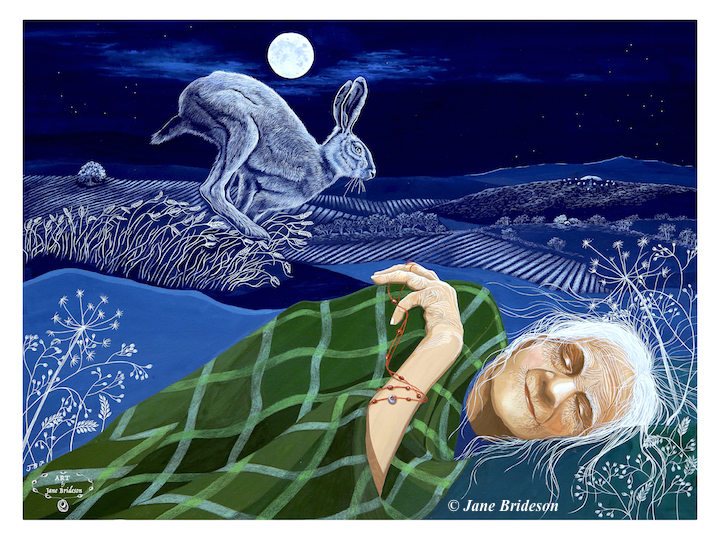

"Into a Hare" by Jane Brideson.


The cycle ended I sensed the wholeness in the land.


***

Next morning, an old woman once again, I rose and placed the kettle on the range for tea.


The phone rang. 
I knew that smiling voice,  “All’s well?” 
“ Yes. The harvest’s saved, great goodness in the grain this year. 
 We’ll celebrate at Samhain so?” I asked.

“Ah, we will of course” came his reply. We laughed and I could see that twinkle in his eye. 
The Dagda’s parties were legendary.


Saturday, 2 April 2016

LOUGH GUR - “a personality loved, but also feared.”

The land surrounding Loch Goir, Lough Gur in Co. Limerick 
has been inhabited continually for 6,000 years.  


Early Bronze Age wedge tomb on the shore of the Lough.


Pics: loughgur.com & ancientireland.org

The bronze Lough Gur Shield, known as the ‘Sun Shield’, dates to 700 BCE 
and appears on the beautifully designed information boards adjoining the lake.

Stone circles, standing stones, tombs, barrows and hill forts dot the landscape 
and there is a wealth of folklore. 


However, the heart of this sacred landscape is the Lough. 

Although it was a spring day when I visited, the water was still and silent, holding mysteries 
dimly remembered in folk tales. 


“ Lough Gur dominates the scene. It was to us a personality loved, but also feared.
Every seven years, so it is said, Gur demands the heart of a human being.”


It is believed that Lough Gur was originally a circular lake belonging to Fer Fi
leader of the Tuatha Dé Danann and brother of the Goddess Áine, who has her palace beneath 
the waters.
As Bean Fhionn, the White Lady, it is Áine who summons a victim to the lake every seven years and takes them to her realm below. 


“Called the Enchanted Lake; some say that in ancient days there was a city where the lake is now.”


Áine is described in folklore as a fairy Bean-tige, housekeeper to Gearóid Iarla, the enchanted son of one of the Earls of Desmond.
Gearóid, banished to the lake, is doomed to return every seven years and gallop over its’ surface seated on a milk white horse shod with silver shoes.

Knockadoon © michaeldebarra.com

The hill of Knockadoon, once an island, has on its’ shore a rock formation 
known as the Suideachan Bean-tige, the Housekeeper’s Chair, 
which is the seat of the goddess Áine. 


Pic © Derek Ryan Bawn - more information The Tipperary Antiquarian

Also known as Áine’s birthing chair and the Old Hag’s Chair, 
no mortal may sit on this stone without losing their wits.

© 2015 National Folklore Collection, UCD. 

Across the Lough from Knockadooon stands Knockfennel, named for Áine’s sister. 
It is understood that this hill too is hollow and within resides Fer Fi, the king of the fairies. 

Knockfennel

His realm is entered through a cave which has a small opening at the back.
“It was said anyone who had the courage to squeeze through the hole would find himself in the hollow heart of the hill.”


Entrance to the Otherworld courtesy of The Standing Stone.
More photos of the cave can be found on The Standing Stone.ie  

In the distant past on Samhain night, when the bonfire was lit on Knockfennell and on the sixth night of every moon, the sick were brought out into the moonlight to be healed. 
This night was known as ‘All-Heal’.

If the patient did not recover by the eighth or ninth night of the moon they would hear the ceolsidhe, the fairy music which Áine brings to comfort the dying. 
The music itself, the Suantraighe, is sleep music played by Fer Fi on his harp .

“They say the Suantraighe is the sweetest tune of all, 
and that anyone who hears it falls into a trance with its beauty. 
But ‘tis a sleep from which no mortal man or woman will ever awake.”

Words of the late Tom McNamara, local seanchaí, storyteller. 


Lough Gur Heritage Centre - loughgur.com
The design of the centre is based upon the ancient lake-dwellings.


Today Lough Gur is a wildlife sanctuary, popular with local people and tourists yet there is a feeling of stepping into a landscape still alive with the old stories. 

And once the visitors have departed and the Lough settles into night

Moonlight over Lough Gur © Michael de Barra.

The Shining Ones race in their boats across the water whilst Áine’s enchantment remains irresistible 
to those who hear her call. 


‘The Enchanted Lake’ Video - Nicky Fennell, produced by Mike McNamara.


To hear more stories about the Lough from the late Tom McNamara 
please visit Voices From The Dawn.


Saturday, 12 March 2016

The Dagda’s harp brings in the greening.


There is a gentle green that hovers like mist about the trees.


Leaf buds prepare to burst forth, birdsong fills the air and Ireland has awakened.

In Irish mythology the land, its’ sovereignty and fertility, were the province of the Goddesses 
but The Dagda, the Good God, also played his part in providing for the people.

AN DAGDHA - more HERE.

We are told that he possessed two great treasures; a magical harp and the cauldron, Undry, which contained endless bounty "from which none returned unfulfilled".


'The Cauldron of the Dagda' by Paula O’Sullivan 
which stands in Tralee’s Sculpture Garden of the Senses. 

As leader of the Tuatha Dé Danann, he used his strength to clear twelve plains overnight, then created twelve rivers, to provide fertile, agricultural land and streams which brought “produce from the sea to tribes and kindreds.” 


A symbol of his virility was described by the antiquarian John Garvin in 1940’s as Bod a'Daghda,  the Dagdha's Penis.


The phallic Dagda's Stone, known by some as ‘the Dagda’s Dick, 
in the Bricklieve Mountains.
Photo © Martin Byrne courtesy of Carrowkeel.com

In Ardmore, Co. Waterford was the Cloch Daha, a stone which may also have been associated with the Good God. 
It was described as having a trough-like shape with a oval hole at the centre. 

Drawing of the Cloch Daha. 

The folklore of Ardmore tells of a tradition where the young unmarried men of the village inserted a pole into the hole of the Cloch-Daha then fixed a rope onto the top. 
Local single women would dance around the stone holding the rope so that the pole spun around. 
The custom ended with the young men pulling the women through the village seated on logs of wood. Owing to the sexual overtones these rites were stopped, the stone removed by the clergy then buried in the last century. 


The Cloch-Daha is thought to have been found and sits in the grounds 
of Monea House, Ardmore.


Only a few symbols of male fertility can be seen in the landscape.

Maghera, Co. Down.
Pic courtesy of Beyond the Pale

The Ballygilbert stone, Co. Antrim. 
Pic courtesy of Megalithamania


Male exhibitionist figure known as the Sean-na-Gig part of a gatepost, 
Ballycloughduff, Co. Westmeath.


However, The Dagda, it is believed controls the crops and harvest from his Otherworld home. 


Whilst, unheard by mortal ears, his magical harp plays on, calling forth the greening of the year.


Information about Ireland’s phallic stones can be found HERE and male exhibitionist carvings HERE