Showing posts with label An Cailleach. Show all posts

Sunday, 1 April 2018

TALES FROM THE CAILLEACH - Enough Old Women around for the magic to survive.

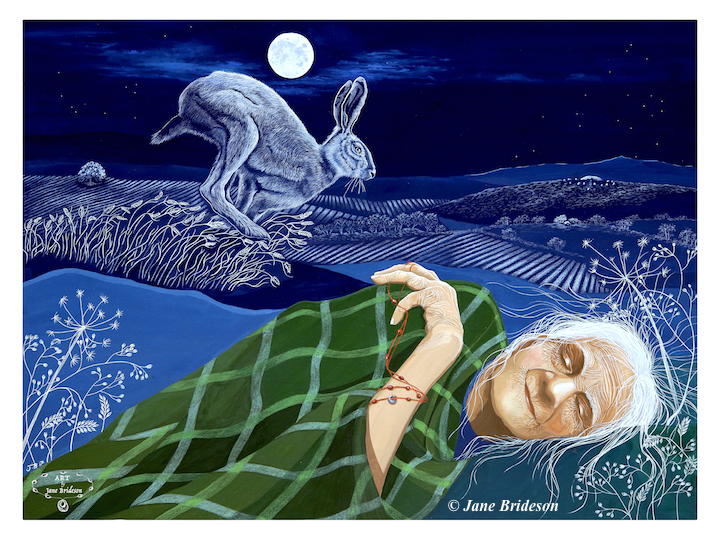
Outside a predatory wind circles, indoors the fire is red and I have company to share the long hours with.
“ I’ve made the tea, you take in the brack and butter. We’ll sit by the hearth.”


Soon a comfortable silence blankets the room as we gaze into orange depths.

“Why are you smiling, Granny?"

“Ehh. Oh I was just thinking about my sister, mo chroí. 
She was a woeful show-off back in the day, still is. 
This one time I caught her out, good and proper. Took her centuries to live it down.”

“Go on, go on, tell me what happened.”

This tale will take a while so I add more turf and take a good sup of tea. 

“Well this was donkey’s years ago, when we roamed all over, wild we were, only settling now and then when the mood took us.
My sister, Garavogue, was full of mischief and wherever we lived she delighted in taking eggs from the neighbours’ hens and stealing milk from their cows.
Skilled in charms she was and I remember she only had to chant the words “All the butter to me” three times and butter would fly from the churns into a bucket she held.
She caused some trouble I can tell you.

Anyway, this one evening an old farmer comes to my door looking for help.
He sat on the hearth like you are now and explained that his cows were giving less milk each day, 
his wife could no longer make butter to sell and he worried for the children.
A couple of his neighbours reported seeing a hare scampering amongst the herd at dusk and as soon as he said that I knew who it was.

Garavogue.
Taking the shape of the hare comes easy to us and drinking milk straight from a cow was just her style, so I thought it was about time she had a taste of her own medicine. 


I told the farmer to go to the field with his friends that night and take their dogs with them. 
They were to hide and wait for the hare and when she came to the herd they were to let the dogs loose. 

I stood at my door at sunset.


I didn’t have to wait long either, as soon as the moon came up there was barking loud enough to be heard in the next parish.
The hare circled the field followed by the dogs, faster and faster they ran until one managed to sink his teeth in her leg. 
That spurred the hare on even more and soon she bolted from the field and ran up the boreen opposite.”


I poured a hot top on the tea and helped myself to brack.

“What happened then?”

“Well, the men called off their dogs and the farmer hurried along in the tracks of the hare, down the boreen to the old cottage. 
He burst through the door and what did he find?

Only my sister Garavogue, collapsed in her chair. 
She was nursing her leg, wrapping it in moss to stop the bleeding.
Not a word was spoken. 
She’d been found out and that was enough to put a stop to her shenanigans.
The next morning when I opened my door there was a basket of eggs and a bottle of poitín on the step, payment from the farmer.”

“What about your sister? Did she know it was you?”

“Ahh well, that evening Garavogue herself came over. 
Her limp was only slight, we Old Women heal fast. 

“Any news ?” she asked

“No, nothing strange or exciting” I told her as I put out plates.
“You’ll have your tea of course, there’s eggs on the boil and a drop of poitín while we wait.”

She spied the fresh bottle and she knew, I saw the twinkle in her eye.
She smiled at me and raised her glass ‘Sláinte!’


She got her own back of course, played many a trick on me and the others over the years.”


“Tell me more granny, please.”

“Not tonight, it’ll be time to sleep soon.”

“But just tell me … do all grannies do that? Turn into a hare and run about the fields?”

“ Not all of them, mo croi, but there’s enough Old Women around for the magic to survive.”


***

This tale of The Cailleach and her sister is based upon folklore from Co. Louth.
A wealth of collected Irish folklore is now available online at Dúchas.ie

Images & Words © Jane Brideson.


Sunday, 24 December 2017

A millon stars, a thousand candles.

Though the Solstice has passed the nights are long.

I walk through sleep-wrapped villages where turf smoke hangs low. 

Climbing the cold hills, all is silence.

Above a million stars.


Below a thousand candles burn in windows to welcome the weary.


***


Traditionally across Ireland a candle is left burning in the window on 24th December.
For many it symbolised a welcome to Mary and Joseph, to others the reborn sun after Solstice.

To all, the candle is a sign to wanderers that they will receive a warm welcome, food and a place to rest this night.


Thank you for taking time to visit The Ever-Living Ones.

As daylight lengthens may it bring you good health, good food & good company!


Sunday, 29 October 2017

Tales from The Cailleach: INTO A HARE


A sharp sickle hangs above the Lough Field.


By the hearth I rest my bones, thoughts conjured by shifting shadows.
How much reaping have I seen since those first seeds were planted?


How many harvests by scythe, then horse now harvester?


In bygone days they thought my spirit in the corn.


Cutting the Cailleach, Co. Antrim.
Pic © www.duchas.ie


At times my hare-shape, spied amongst the stalks, caused old ones to make the sign and murmur against ill-wishing.  
They recognised my power.

Still now, at my great age, I go about at harvest to fulfil my duty. 
Barley, wheat, oats and grass, all are judged for fitness.
This year was no exception.


At the swollen moon I lay besides the hearth, shawl wrapped tightly, trusting my gnarled fingers 
to remember. 

Nine haws, nine knots, a hag stone bound in red. 

Eyes closed I breathed archaic words upon the charm.


Damp earth-scent replaced turf smoke. 

I diminished, 

I re-formed.


Detail from "Into a Hare" by Jane Brideson.


A twitch of whiskers then I was off across the silvered land.


Past Lone Thorn, 


Detail from "Into a Hare" by Jane Brideson.


Shining Mound


Detail from "Into a Hare" by Jane Brideson.


and Sacred Well.


Detail from "Into a Hare" by Jane Brideson.


Around the Hag’s Hill then spiralling far beyond. 

Fulfilling work began at EQUINOX 


"Into a Hare" by Jane Brideson.


The cycle ended I sensed the wholeness in the land.


***

Next morning, an old woman once again, I rose and placed the kettle on the range for tea.


The phone rang. 
I knew that smiling voice,  “All’s well?” 
“ Yes. The harvest’s saved, great goodness in the grain this year. 
 We’ll celebrate at Samhain so?” I asked.

“Ah, we will of course” came his reply. We laughed and I could see that twinkle in his eye. 
The Dagda’s parties were legendary.


Sunday, 30 July 2017

LUGHNASADH - Gathering Fraochans at Brón Trogain.

Along the boreen flowers are becoming fruits and the year is turning towards Lughnasadh.


Honeysuckle flowers depart & berries appear.

The earliest name for Lughnasadh, derived from Old Irish, is Brón Trogain, which likens the earth to a woman in labour, sorrowing as she births her fruit.
As green berries are revealed, the first wild fruit to ripen is usually the fraochan.


Also known as fraughan, bilberry, whortleberry, blaeberry, heatherberry, whorts & hurts.


Fraochans have been known in Ireland since ancient times and their seeds have been discovered during excavations of Viking and Anglo-Norman settlements in Dublin. 

Across rural Ireland it was customary to celebrate this time of year by visiting the heights of the land to pick the berries. 


Purple dye was produced from the berries and the juice was believed to be a cure for eczema

The shrubs grow low on heathland and wet mountainsides where their solitary flowers produce purple-black berries, rich in vitamin C.
Bilberries were traditionally gathered on the last Sunday of July or the first Sunday of August and Domhnach na bhFraochog, Fraochan Sunday, was considered a day of great festivity when people danced, sang and played games in the wild places. 


Ard Éireann on the border between counties Laois and Offaly, 
was a popular place to harvest fraochans.


In 1942 massive crowds were reported as streams of cars, pony traps and bicycles from the surrounding countryside made their way to Arderin to pick the berries.


Large quantities of bilberries for export to Britain were harvested in Carlow, Wicklow, Tipperary and Waterford in the early 20th century. The price paid was very low and the baskets large but hundreds of people picked them to earn money to support their families.


During the 2nd World War imports of bilberries to Britain from Europe were disrupted resulting 
in the price paid to Irish pickers increasing dramatically, especially as British pilots 
reported that bilberry jam improved their night vision.


In earlier times the gathering of fraochans appears to have involved only the young people who would spend the day walking to the slopes, foraging for berries and celebrating. 
In Co. Donegal the aged were not allowed upon the hill tops so berries were strung on long stalks of grass, cuiseógs, to be brought down to them. 


At Glenkitt, Co. Laois people gathered to climb the slopes of Ard Erin in search of berries.


Many accounts describe Fraochan Sunday as a time for courtship, a festival where people could hope to find a husband or wife.
Young men threaded berries, making bracelets as gifts for the young women. 
Custom dictated that the bracelets had to be removed and left on the hill top at the end of the day, although the reason for this has long been forgotten.


A plentiful supply of the berries were thought to bring good luck to the coming harvest.


Bilberry pies called Pócai Hócai, were made by young women to be presented to their chosen partners and fraochan wine, a mixture of sugar and berry juice, was given to lovers in the hope of hastening a wedding.
Perhaps the tradition of courtship associated with Bilberry Sunday is an echo of the old Teltown Marriages lasting for a year and a day, which also took place at Lughnasadh ?

Gathering bilberries upon the heights brought people to the hilltop mounds and fairy-forts and there are accounts of the Old Gods and the Good People being honoured at this time. 


A celebration was held on Knockfeerna Hill, Co. Limerick where flowers and fraochans were strewn around a small cairn, the ‘Struicín’ near the summit, reputedly the entrance to 
Donn Fírinne’s underground palace. 


On the small hill, the Spellick, near to Slieve Gullion, Co. Armagh, everyone who gathered fraochans had to sit on a rocky formation known as the Cailleach Beara’s Chair, for luck.
However Crom Dubh, the ‘black stooped one’, was the pagan deity most associated with the festival and gathering berries any later than Fraochan Sunday was thought to bring his curse. 


Of the many traditions associated with Brón Trogain, later Lughnasadh, it appears that Fraochan Sunday has stood the test of time. In many areas people still pick fraochans on the hills. 


Here in the midlands Ard Erin was silent this year and Glenkitt a lonely place, 
but the fraochans are still thriving on the hills. 
***

Take a sound journey through Glenkitt to Ard Erin with local guide Mick Dowling who remembers the days when thousands gathered on Frochan Sunday. 


Sunday, 19 March 2017

Tales from the Cailleach: Tipping the Balance at Equinox.

A short walk today, just as far as the thorn. 
The Equinox sunrise gilded the stones within my mound this morning.


Photo: sunlight at Spring Equinox inside Cairn T  © Clare Tuffy http://www.newgrange.com 


Seed-sprouts rise from the earth, tiny leaves curl on branches.
Still, there is a breath of snow in the air and on these grey days I don’t stray far from the hearth.

The fire awakened, I sit staring into the flames, warmed by memories of SAMHAIN past. 
Since then I have a ready smile for neighbours and laughter in my eyes. 
They do not know the cause but I see them sniffing the air as they pass, sensing sea tang, their faces puzzled by the seaweed fond across my threshold. 

The phone rings, reflections shatter.
Two voices, so like my own, whisper down the line.
“ Tonight, is it?”
I nod my reply.
“Yes, we’ll tip the balance. ”


Later, fire banked, I listen to the house as it sighs and settles into the night.
Once the tale was told of we three Hags who push up new growth from the land at Equinox, it’s almost true that story.
My sister-selves and I labour when light and dark are equal but not beneath the earth.

As shadows deepen, eyes close, breathing slows and I gently slip away.

Needing neither broom nor steed I rise to travel rimed roads. 
Sleep blankets the villages I pass, a quiet night in this world.
Over frost bitten bog and pitch river I gather speed to soar above the rising hill.


Photo © Lynda McCormack 


A feathering of snow flakes as I settle upon Sliabh na Caillíghe, where once we leapt and hurled 
the stones that now bear legends.

Upon my chair I scour the sleeping island with keen eyes.


Photo: Courtesy of © Anthony Murphy http://www.mythicalireland.com 


Yes, the land is ready, ripe for growth. 
I release my howl of greeting high into the darkness.  
A chill blast bearing laughter replies, my sister-self on Gullion. 
A moment later the screech of Bheara answers and we three Hags are ready.
The tipping point approaches.

At the mound, breath hoar frost on stone, I enter black stillness.
In this womb, the air, already laden with the scent of meadowsweet yet to bloom, 
shifts as I trace shapes within the stones. 
Patterns once danced upon the land in rhythm with earth, sea and sky.


We three move as one. 


Goodness in seed, grass and grain.

Sunwise circling.


Goodness in flower, fruit and branch.

Weaving words.


Goodness in grain, nourish our people.


A sudden surge. 

A torrent, the yellow of ripening sun, is birthed across the land. 

The point of balance tipped.

The land awash with vigour once again.


Cailleach at Sliabh na Caillíghe © Jane Brideson.

***

Next morning, I stir the embers back to flame and place the kettle on the stove, my work complete 
till harvest.

Stepping out the sky is washed pale blue and Seán stops the post van by the gate. 

“ Not a bad morning,” he says, “ there’s a feel of spring to the air. ”
Handing over the bills he stays to chat until the kettle sings. 
“ No tea for me today. ” 
Leaving he sniffs and mutters, “ is that the sea ? ”

I look to the sky. 
From the west a cloud formed like a wave rolls across the hills.


Inside two cups sit ready.
Manannán comes.


My first story of The Cailleach at Samhain is here: The Lament of the Old Woman


Sunday, 16 October 2016

The Cailleach - Hag of the Mill & Mother of the Herd.


Cailleach an Mhuilinn, The Hag of the Mill.


For much of last winter and earlier this year I have kept company with the Cailleach, the Old Woman, the Hag, who appears in many guises in folklore, landscape and myth. 
Her great age, her ability to fly, to shape shift into animal form, her role as a Sovereignty goddess and her links to wild animals marks the Cailleach as a supernatural being, an ancient goddess. 

As Hag of the Mill she is associated with grinding corn and the harvest.


In many places the last uncut stalks of corn were plaited, cut and hung above the door at home as protection. 
This action was known as ‘cutting the cailleach’. 
In others areas it was believed she took the form of a hare who sheltered in an uncut corner of a field to avoid the scythe.

I painted her in her guise of The Hag of the Mill as she appears in Buile Suibne,
‘The Frenzy of Sweeney’, a tale recorded in the 1670’s. 
Rather than illustrate her part in the tale literally, I wanted to portray her energy and wildness. 


You can read the text of Buile Suibhne, translated by JG. O’Keefe HERE


Briefly Suibhne is described as the king of Dal Araidhe in the north east of Ireland. 
When news reached him that St. Ronan Finn was building a Christian church on his land and chanting psalms the pagan Suibhne, having no time to dress, left his home naked and expelled the cleric.

After throwing the psalter into a nearby lake Suibhne is cursed by Ronan to constantly wander Ireland, flying naked throughout the land until killed by a spear.

So he spends seven years leaping from hill to hill, living amongst trees and existing only on watercress. Suibhne appears to lose his sanity but he is eventually caught and left in the care of his kinsman, the miller Loingseachan.  

Suibhne is locked in a bedroom at the miller’s hostel until one day, during the busy harvest when all hands are needed, he is entrusted to the care of Lonnog, The Hag of the Mill. 

She is ordered not to speak to the captive but Lonnog has her own plans. 

She teases the king about his madness and he responds with tales of his freedom and the great leaps he once took across the hill tops of Ireland. 
Finally the Cailleach challenges him to make one more leap, this time through the skylight of the room. Suibhne does so and pursued by the Hag, is free once more. 


Detail - Teach Duinn, Donn’s House of the Dead, identified as Bull Rock, off the coast of  Co. Cork.

They visit Teach Duinn in the west, then travel across the landscape, with the Mill Hag driving him on, revealing to him his past life as a ‘madman’.


Detail - The Cailleach as bringer of winter, mother of the herd.


During their time together Suibhne recounts his meetings with the famous stags of Ireland, remembering his great adventures in the wild and although the king despises the Hag for bringing him back to his old ‘madness’, he recognises Lonnog as an ancient one, the progenitor, Mother of the great herds of deer.

“ O mother of this herd
thy coat has become grey,
there is no stag after thee
without two score antler-points.”


Finally, to be rid of the Hag, Suibhne leaps to Dunseverick on the Antrim coast where he jumps again, followed by the Hag of the Mill.


Detail - cliffs at Dunseverick, Co. Antrim.

The king survives by falling into the sea but the Cailleach lands on a cliff, her body broken, 
she falls into the water. 

After many more adventures St. Ronan’s curse descends upon Suibhne, he is killed by a spear wound and at death the pagan king is given the Christian sacraments.

But what of the ancient Cailleach ?


Later her body washes up on a beach and at that liminal place, between sea and land, 
she is carried away by her Otherworld kin, “the devil’s crew”. 


To this day the Hag, The Old Woman, is remembered and honoured at wild, lonely places across Ireland and at this time, when the harvest is over and winter is almost upon us, perhaps she haunts those places still.


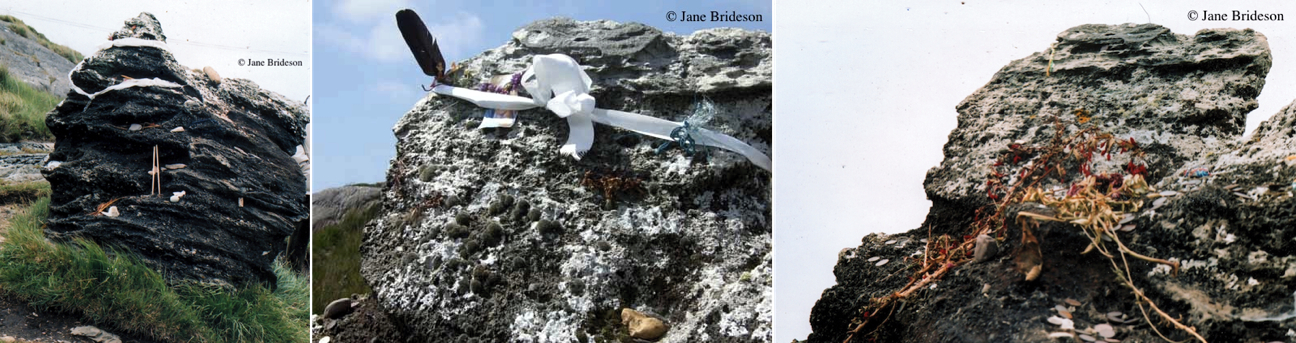
Harvest offerings to the stone Cailleach, The Old Woman of Beara, who looks out to sea from the Beara Peninsula.

Sunday, 8 November 2015

My FaceBook SHOP

I now have a Facebook SHOP where you can buy 
Cards & Prints of my original paintings. 
If you have enjoyed my work on this blog please visit, 
LIKE and SHARE my Page with your friends. 
THANK YOU.
MY FACEBOOK SHOP

If you are on Facebook please drop by & say Hello!


Saturday, 19 September 2015

Portrait of a Wise Woman.


Bean Fasa, Wise Woman © Jane Brideson 2015.
Inspired by the Wise Women of Ireland & the stories of Biddy Early
Model: Mary Kelly

In the past, within rural communities, women guided people through life's changes.
At child birth women would turn to the Handy Woman, Bean Ghúline, the country midwife,
who had visited the Otherworld to refine her skills.
At death it was the Keening Woman, Bean Chaointe, who provided an essential service at funerary rituals.
For life's troubles in between the Bean Fasa, the Wise Woman, was consulted.


The portrait includes Biddy's cottage, hearth & famous blue bottle.

One function of the Wise Woman was that of Bean Leighis, woman healer, who diagnosed the maladies of people
and animals. Her knowledge encompassed cures for bodily ailments as well as mental disorders
and afflictions which had their cause in the Otherworld.


Detail of herbs: 1 Beirbhéine Vervain, 2 Caorthainn corraigh Valerian, 3 Samhadh bó Sorrel, 
4 Athair Thalún Yarrow 5 Beathnua Baineann St. John's Wort. 
Also Airgead Luachra, Meadowsweet & Iúr sléibhe Sage.
Click HERE to read more about the uses of these herbs.

Often an older, single woman, she was a source of wisdom, particularly regarding the Good People from whom she gained her knowledge.
It was the local Wise Woman who was called upon when mysterious injuries or illnesses appeared, when the butter wouldn't come or a changeling was thought to lie in the crib.
Accounts tell of these woman being in regular contact with the fairies, gathering herbs at dawn
and dusk, often attended by a spirit and having the ability to foresee the future. 


Detail - hare & fairy mound.
Accounts tell of several Wise Women transforming into a hares.


One Bean Fasa, in Co. Kerry, was described as frequently falling into a trance at funeral wakes, returning to the assembled company with knowledge gained from the Otherworld.


Detail - Hag Stone.
It was believed that some could see the Good People 
when looking through a natural holed stone. 

The folklore surrounding these figures describes them as almost supernatural elders and
stories of their exploits span many generations. Some were real women, such as Biddy Early,
whilst others appear to be mythical. 


Detail - Biddy Early's cottage under a full moon. 
Water from the well, once near the roadside, flows beneath.


Folklore concerning Wise Women, such as Máire Ní Mhurchu of Bheara, often portray them as personifications of  THE CAILLEACH.

Indeed, the Wise Woman, who often opposed the church and man-made law, was a powerful female, an authority figure viewed in oral tradition as an embodiment of our ancient goddesses.

The Wise Women of Ireland are remembered and honoured by those who visit the places associated with these real and mythical women.


Offerings at Biddy early's cottage © Jane Brideson.


The Hag of Bheara at various times of the year with offerings © Jane Brideson.


I will be producing Art Cards & Prints of  'The Wise Woman'.
To pre-order & for more info please contact me HERE
or on my Facebook Page THE EVER-LIVING ONES


Information about the following Wise Women - Máire Ní Chearbhaill of Carbury,
Máire Ní Mhurchú of Bheara, P Ní L of Tuosist, Eibhlín Ní Ghuinnníola of Dingle,
Máire Liam of Kilworth & Biddy Early of Clare, can be found in
Gearóid Ó Crualaoich's 'The Book of the Cailleach'.