Showing posts with label National Museum of Ireland. Show all posts

Saturday, 11 April 2015

Otherworld shenanigans in Ballygillaheen.

Jim's reminiscences of the old days included some tales set in Ballygillaheen, a townland half a mile away where he went to National School as a child.  
Ballygillaheen is now a scattering of houses but back then many families lived there and although
the walk to school was an easy one for Jim it took him past the dreaded Comb Field.
This field was renowned because it was here that the Banshee's comb was found. 

The Comb Field today.
The Banshee, Bean sí, or female dweller of the fairy mound, is a supernatural being said to follow certain old Irish families. She brings the message of approaching death to family members by visiting them or by wailing at night near their homes.  

This particular Banshee frequented Ballygillaheen dressed in white and could be seen on certain nights combing her long grey hair with a comb fashioned from white bone. 
One time her visits became more numerous, as though she was searching the area for someone or something. No deaths occurred so it was finally understood that the Banshee had lost her comb. 

Ancient Irish ornamented Combs, made of bone, now in the National Museum.
Pic ©libraryireland.com

A local lad found it in the field not far from the school and he had sense enough to leave the comb where it was. He knew that if he took it home she would visit him that night to retrieve it 
and no one wanted a visit from the Banshee.

A woman not far from the area was not so lucky and the story, recorded in 1976, was recounted by her granddaughter, Bridie Dunn:

" ... my grandmother ... was telling me that she was going home from town one day. 
She picked up a lovely comb and brought it home with her. And that night there was an awful noise at the door and the old man said he would get up and see who it was. So she told him not to. 
And he suddenly saw the comb and he put the comb on the tongs, you know, and sure he put
the tongs out the door with the comb and the tongs were broken in his hands."*

In many places similar tales are told concerning the Banshee searching for her comb and it is well known that you should not face her directly and never touch her. 
The best way is to pass her the comb through a window or a partly open door and always to place it on tongs, a shovel or any iron implement which gives protection against Otherworldly forces.

The best advice was given to me by Jim, "if you do find a comb, it is better to leave it where it lies."

As far as I know the Banshee of Ballygillaheen finally found her comb as the area has been quiet
and she has not been seen now for several years.


* This tale is local to where I live and was recorded under "Comb Legends" in Patricia Lysaght's excellent. in-depth study of Banshee folklore in Ireland - 


"The Banshee - The Irish Death Messenger" available here:


The 'Otherworld Shenanigans' posts are based upon the tales and reminiscences of my elderly neighbour, Jim, who lived his life in the same house he was born in.
Jim died several years ago and is remembered as a real character by those who knew him.

Saturday, 22 November 2014

The Mists of Manannán Mac Lír.

As a child I spent many summers living with relatives on the Isle of Man, Ellan Vannin,
and was told stories about Mannin by my Grandmother, who was a native Manx speaker.
The one I remember most clearly told how he would spread his cloak of mist and magic across the island to conceal it from invaders, especially my Grandmother stressed, the British monarchy!
During the past couple of days we have been marooned in a sea of mist and silence and I have
been inspired by her stories and the weather to post my painting of Manannán.
I recently stumbled across As Manx as the Hills on Facebook and also discovered the wonderful
statue of Manannán by the sculptor John Darren Sutton.
His god stands on Binevenagh Mountain, Binn Fhoibhne, Co. Derry overlooking Lough Foyle.
Local tradition tells of the presence of  Manannán in the Lough and it was believed that his spirit 
was released during fierce storms. 
My painting of him illustrates him as a god of the sea, water, mists and magics.


More about my painting - HERE


Flor, the model for my painting Manannán.


1 The Isle of Man which takes it's name from Manannán can be seen on the horizon. 

Above the island flies the crane, a bird associated with Manannán and his crane bag.
2 The god is also associated with lakes and several castles, such as Castle Mannin, Co. Mayo 
and Mannin Castle, the remains of a ringfort, in Co. Monaghan. 
This stands near a lough known as Mannin's Pool and local folklore tells that St. Patrick fought here with Manannán and defeated him by confining him to the water. 
Manannán however escapes on occasion and has been seen by local people in the form of a hare.

3 The triskelion, the island's symbol known as the "three legs of Mann", Tree Cassyn Vannin.

4 He is also believed to inhabit the isolated rock of Carrickmannon. 
Found about 1 km offshore to the north east of Kinbane Head, Co. Antrim,
the rock is submerged and it is only at low tide when the waves break across it,
is Manannán's home visible.


Low tide at Carrickmannon from www.panoramio.com

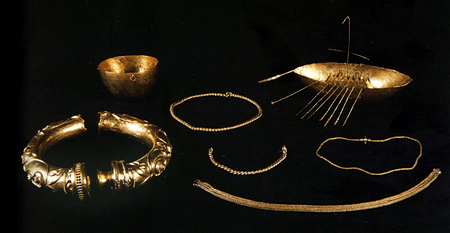
5 Manannán offers the golden boat, part of the Broighter Hoard, found in 1896 and thought to be
a ritual offering the god when the area was underwater.

The gold boat is on display in the National Museum of Ireland, Dublin.


Photos of Broighter Hoard from Irish Archaeology  HERE

6 & 7 From the waves emerge Manannán's horse, Aonbharr and the Salmon of Wisdom 
who lives in the well at Emhain Ablach, one of Manannán's home.

8 Manannán's boat journeys towards the Blessed Isles, to Tír Fo Thonn, the Land Beneath Wave and Tír Na Nog, the Land of Youth.


Manannán overlooking Lough Foyle:
Manannán by John Darren Sutton

Manannán overlooking Lough Foyle by John Darren Sutton


The work of sculptor John Darren Sutton can be found here - JD SUTTON
Photographic prints of his work - Here
You can also see him here too.


Sunday, 19 October 2014

MÓRRIGAN / MÓR-RÍOGHAIN


1 She offers a gateway into darkness and the entrance to her cave,
Uaigh na gCat, Owenygat, in Co. Roscommon.

Owenygat : photo © www.rathcroghan.ie

2 Two mounds near Brú na Bóinne known collectively in mythology as Mur na Morrigna,
‘The Wall of the Mór-Ríoghain or Great Queen’ and later as Da Cich na Mórrigna,
'Two Paps of the Mórrigan'.
One text names these mounds individually as cirr & cuirrel,  comb and brush of
the Dagdha’s wife. Today they are referred to as satellite mounds K and L, passage graves
which contain decorated stones. 
Below them stands the stone known as the Lia Fáil on the Hill of  Tara, Co. Meath
where the Mórrigan resided for a time.
The stone now commemorates the graves of the Croppy Boys of 1798.


Paps of Anu, Co. Kerry.

3 Da Chích Anann, the Paps of the Goddess Anu, who was associated with the Mórrigan.
Between the mountains lie Gleannfreagham, 'The Glen of the Ravens'.

4 Below the Paps is Gort-na-Morrigna, Mórrigan’s field, Co. Louth, which in Irish mythology
was the gift given to the Mórrigan by her husband, the Dagdha.

Drombeg: photo © Megalithic Ireland.com
5 Several fulacht or ancient cooking places within the landscape are known as Fulacht na Morrigna,
Mórrigans' hearth. When the Goddess resided at Tara her cooking spit was famous for its' size
and ability to hold and cook three sorts of food at one time.


6 Within the hearth sits a cauldron from the Late Bronze Age found in a bog in Castlederg,
Co. Tyrone and believed to have been made for ritual purposes.
The bronze cauldron is on display in the National Museum of Ireland, Dublin.

Bronze cauldron: © 100objects.ie
7 Within the rising steam curls a wolf, a raven & an eel each of which the Mórrigan,
as shape-shifter, transformed into.


8 The final element of the painting shows the River Barrow.
The Goddess is associated with Samhain and with various rivers also appearing in mythology as
the 'Washer at the Ford', an aspect of the Mórrigan who prophecies the death of warriors in
forthcoming battle by standing in a stream washing their bloody armour.

We are also told that The Mórrigan had a son, Mechi, who had three hearts each containing
the shapes of three serpents within them.
Mac Cecht killed Mechi so that the serpents would not grow to consume or blight the island.
He removed the hearts, burnt them and threw the ashes into a river which boiled up.
The 'boiling'  river, the berba, is thought to be the River Barrow, one of the three sister rivers.

The model for the painting was Carmel Ní Dhuibheanaigh.


Carmel

Please also visit:
http://www.rathcroghan.ie
http://www.voicesfromthedawn.com/drombeg-stone-circle/
http://storyarchaeology.com

If anyone is interested in cards or posters of the Mórrigan please email me at -
morrigan@mac.com 


Sunday, 2 February 2014

Imbolg and Brigit's Day

Lá Fhéile Bríde shona dóibh go léir - Happy Brigit’s day to you all.


The snowdrops in our garden arrived in time for Imbolg and the storms abated enough to allow me to wade into the Lough Field next door to gather reeds for the Brigit's Crosses.

The St. Brigit's Cross, which many consider to be a solar symbol connected to the Goddess Brigit / Bríde, was made for protection against fire, storm, lightning and illness and was in the past condoned by some priests and condemned as superstition by others. 

They are still made by women across Ireland to protect the home and family and hung above the front door or hearth.

Today the well known four-armed cross below is most popular but in times past the design of crosses varied depending upon where you lived and could be made from straw, rushes or reeds.


Four-armed Brigid's Cross originally made in Co. Leitrim.

Three-armed Brigit's Cross.
The three-armed cross was traditionally made in Co. Donegal or in other parts of the island where it was made to be hung in the byre to protect the animals.

Woven cross originating from Co. Derry.

In some areas last year's Brigit's Cross was taken down but usually the old crosses were left in place and a new one added so that it was common to see several pinned to the underside of a thatched roof.


A new cross now hangs above our hearth and the Goddess Brigit protects and blesses our home again.    


Thursday, 3 January 2013

Aengus Óg


Aengus Óg © Jane Brideson 2013


The Blessings of the Returning Sun to you!


AENGUS ÓG
Aengus Óg, 'young Aengus' is the Irish god of love, youth and poetic inspiration. 
At the top left can be seen the Milky Way, in which the constellation of Cygnus, 
the Swan, is rising. Below is Red Mountain, Co. Meath where the sun rises at 
Winter Solstice before entering Newgrange.
To the right is Dún Aonghasa, the prehistoric fort on Inis Mór, Aran Islands. 
 The twisted gold collar circling the neck of Aengus dates to the early Iron Age and was found at Ardnaglug, Co. Roscommon.
Aengus is associated with the 'new' sun at Winter Solstice and within his body can be seen the sunlight entering the passage at Newgrange. 
As the reborn sun his gentle light illuminates the land, shining on the Brú and bringing the promise of spring.
At the bottom is the River Boyne on which swim two swans, Aengus and Caer, the swan-girl he fell in love with after seeing her in a dream.
The twisted gold collar is on display in the National Museum of Ireland, Dublin.