Showing posts with label Paps of Anu. Show all posts

Sunday, 29 May 2016

Sacred water and three thousand Holy Wells.


Well at Cahercrovdarrig, Cathair Crobh Dearg, near the Paps of Anu.

3,000 sacred wells have been recorded in Ireland, although this is believed to be a conservative number. There are numerous others which are undocumented, whose locations cannot be found or have been forgotten over time.


Frequently marked Tobar Naofa on maps, they are the blessed wells, springs and water sources found in every part of the island.


Sign by the Sacred Well on the Hill of Tara.

In countless instances the original Irish names are also lost to us.
Many were re-dedicated to saints of the church by the clergy, others were known by the names of early saints or well known figures, still venerated by local people.


The entrance to the site of St. Brigid’s Well, Liscannor, Co. Clare.
The approach to the well is through a cave-like tunnel with offerings piled on walls and shelves.


Well of St. Inghean Bhaoith, Co. Clare, who has a widespread devotion locally.

There are wells named for their healing properties with cures including those for sore eyes, toothache, arthritis, mental ailments and in the past cholera.


St Cooy’s Well known for it’s eye cure.

Whilst others take their titles from figures and animals of myth or folklore. 


Well of the Fair Women above Cahersiveen, Co. Kerry. 

Each well has it’s own personality.

There are wells housed in stone and maintained by the faithful.


St Anastasia's Well, Co. Clare.

Many lie open to the elements or are marked by a lone tree.


Well near the remains of the church of St. Manman, Co. Laois.

Sacred wells emerge in verdant hollows 


Tobar Mac Duagh, Co. Galway.

and from inhospitable landscapes.


St. Fachtnan’s Well on the Burren.

Water pooled in bullaun stones and in the trunks of trees also offer cures.


City wells, now forced underground, still flow as the modern world flourishes above.


St. Patrick’s Well beneath Nassau St. Dublin.

The liminal places, shores, caves, heights and islands also have their wells.


St. Augustine’s tidal well on the shore of Lough Atalia, Galway.


Chink Well in a sea cave at Portraine, Co. Dublin.
Courtesy of Treasa Kerrigan http://www.sacredsites.ie

The sanctity of these wells comes from the water itself which emerges from the earth as a gift from the gods of the Otherworld. These sources were venerated by the ancient people who built their megaliths close by or incorporated them into the structure. 


A natural spring still rises from beneath one of the huge stones in the passage of Newgrange 
and would have flowed as a small stream across the floor. 
The water from the spring is now re-routed to an exterior sinkhole.


St. Patrick’s Well below the reconstructed Grianán of Aileach, Co. Donegal.

Water has its’ own active life force at sacred wells and to ensure it wasn’t sullied or used for domestic purposes, cautionary tales were passed down through generations about wells which, when offended by humans, protested by moving location.


Áirmid’s Well, now Lady Well, at Slane, Co. Meath. 
Folklore tells how it moved to its present position when attempts were made to seal it.  

Aggrieved wells travelled after midnight, some accompanied by the Good People, in order to punish those who washed clothes or disposed of refuse in their waters. 
Others had the power to curse their transgressors by affecting their health or poisoning the guilty 
and their cattle but in many cases water taken from a holy well to be used in cooking merely 
refused to boil.

Stone by well on the Hill of Tara. Pic © taratrees.org


Many of Ireland’s sacred wells have been a focus for ritual, veneration and healing for thousands of years, their waters connecting us to deities and spirits. 
Visiting these wells today we are offered a special stillness, a place apart, where quiet reflection surrounded by nature is therapeutic and inspiring.
Whether we find these wells in countryside or town, whether our belief is Pagan, Christian or nothing at all, they continue to fill a deep need in us all.


Michael Houlihan’s book “The Holy Wells of County Clare”  provides a deeper understanding of Irish sacred wells and can be ordered from the author at:   michaelhoulihan5@gmail.com.


For a fascinating investigation into the sacred wells of Co. Dublin, I thoroughly recommend Gary Braningan’s book “Ancient and Holy Wells of Dublin” available here:


Sunday, 13 December 2015

Mythical figures across the land.

In Ireland mythology is everywhere, in landscape, place names, at sacred sites, wells and rivers.
Within cities too the work of artists and sculptors remind us of ancient stories.


Queen Maeve -  Bronze statue in Beresford Place, Dublin. Created by Patrick O'Reilly.


In places the Children of Lír still emerge changed by Aoife into four white swans. 

 The Children of Lír, Dublin Garden of Remembrance. Created by Oisín Kelly.


The Children of Lír, Lough Owel, County Westmeath. Created by Linda Brunker.


The Children of Lír, Ballycastle, County Antrim. Artist unknown.

Our goddesses, gods and heroes still grace the land.


Sculpture of Étaín and Midhir by Éamonn O'Doherty 
standing in the park near the Ardagh Heritage & Creativity Centre.


Princess Macha at the entrance to Altnagelvin Hospital, Co. Derry by F.E Mc William. 
Macha was said to have founded the earliest hospital in Ireland. 


Éire with harp by Jerome Connor, Merrion Sq Park, Dublin.


The dying Cú Chulainn by Oliver Sheppard can be seen in the GPO, Dublin
and is a memorial to the participants of the 1916 Rising.
 Bronze statue of  Cú Chulainn carrying his dying friend Ferdia 
by Ann Meldon Hugh, Ardee, County Louth. 

Lúgh Lámh Fhada by Séighean Ó Draoi on the shore of Lough Dunlewy
 at the foot of Mount Errigal, Co. Donegal


Manannán by Peter Grant, The Mall, Castlebar, Co. Mayo.


Sea God Manannán  by Ann Meldon Hugh, Dundalk, Co. Louth. 

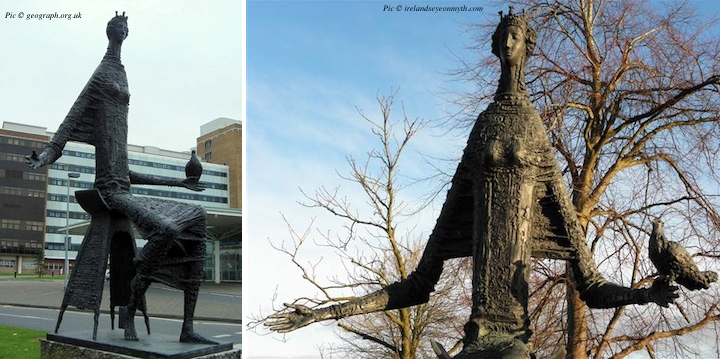
One has been taken

The stolen statue of Danu who once stood near the Paps of Anu, Co. Kerry.

and one has returned.

 Manannán Commands the Sea by sculptor John Darren Sutton. 

In a moment of syncronicity when I  began to write this post I heard that the statue of Manannán Mac Lír, stolen back in January and recovered, will be erected again to look out from Binevenagh Mountain, Co. Derry towards Lough Foyle.

Welcome back!


Sunday, 19 October 2014

MÓRRIGAN / MÓR-RÍOGHAIN


1 She offers a gateway into darkness and the entrance to her cave,
Uaigh na gCat, Owenygat, in Co. Roscommon.

Owenygat : photo © www.rathcroghan.ie

2 Two mounds near Brú na Bóinne known collectively in mythology as Mur na Morrigna,
‘The Wall of the Mór-Ríoghain or Great Queen’ and later as Da Cich na Mórrigna,
'Two Paps of the Mórrigan'.
One text names these mounds individually as cirr & cuirrel,  comb and brush of
the Dagdha’s wife. Today they are referred to as satellite mounds K and L, passage graves
which contain decorated stones. 
Below them stands the stone known as the Lia Fáil on the Hill of  Tara, Co. Meath
where the Mórrigan resided for a time.
The stone now commemorates the graves of the Croppy Boys of 1798.


Paps of Anu, Co. Kerry.

3 Da Chích Anann, the Paps of the Goddess Anu, who was associated with the Mórrigan.
Between the mountains lie Gleannfreagham, 'The Glen of the Ravens'.

4 Below the Paps is Gort-na-Morrigna, Mórrigan’s field, Co. Louth, which in Irish mythology
was the gift given to the Mórrigan by her husband, the Dagdha.

Drombeg: photo © Megalithic Ireland.com
5 Several fulacht or ancient cooking places within the landscape are known as Fulacht na Morrigna,
Mórrigans' hearth. When the Goddess resided at Tara her cooking spit was famous for its' size
and ability to hold and cook three sorts of food at one time.


6 Within the hearth sits a cauldron from the Late Bronze Age found in a bog in Castlederg,
Co. Tyrone and believed to have been made for ritual purposes.
The bronze cauldron is on display in the National Museum of Ireland, Dublin.

Bronze cauldron: © 100objects.ie
7 Within the rising steam curls a wolf, a raven & an eel each of which the Mórrigan,
as shape-shifter, transformed into.


8 The final element of the painting shows the River Barrow.
The Goddess is associated with Samhain and with various rivers also appearing in mythology as
the 'Washer at the Ford', an aspect of the Mórrigan who prophecies the death of warriors in
forthcoming battle by standing in a stream washing their bloody armour.

We are also told that The Mórrigan had a son, Mechi, who had three hearts each containing
the shapes of three serpents within them.
Mac Cecht killed Mechi so that the serpents would not grow to consume or blight the island.
He removed the hearts, burnt them and threw the ashes into a river which boiled up.
The 'boiling'  river, the berba, is thought to be the River Barrow, one of the three sister rivers.

The model for the painting was Carmel Ní Dhuibheanaigh.


Carmel

Please also visit:
http://www.rathcroghan.ie
http://www.voicesfromthedawn.com/drombeg-stone-circle/
http://storyarchaeology.com

If anyone is interested in cards or posters of the Mórrigan please email me at -
morrigan@mac.com 


Monday, 12 August 2013

Lughnasadh Blessings.


I recently took a break from writing to enjoy the great weather and to visit author, Dan Cronin in Kerry.
We have been writing to each other and talking on the 'phone a great deal after I visited The City last year - see ANU post August 2012.
His book about his homeplace in the foothills of the Paps of Anu was invaluable and Dan, who is 92, is truly an inspiration. 
Dan and Margaret, gave us a great welcome when we arrived and we could have stayed for hours talking about mythology, folklore and life.

Margaret and Dan

Back home we recently celebrated the first harvest, Lughnasadh or Brón Trogain, the older name for the festival at a local site in the foothills of the Slieve Bloom. 


 Tobar Lugna, Lugna's Well, Co. Offaly.
Photo by Colin Russell

The offerings included berries, herbs, flowers, barley and turf.
Photo by Colin Russell


Tomorrow I am back working on the book but wish you all 
Lughnasadh Blessings and a fruitful harvest.


LUGH
Lugh’s name may have its roots in early words such as leuk, 'light' or lug, oath. 
His titles include Lámfhada, 'Long Arm' and Samhildánach, 'Equally Skilled in Many Arts'.
The Milky Way, Sliabhbra Luigh, is known as Lugh's Chain. 

Places within the painting associated with Lugh are:
Carn Uí Néid, Mizen Head, Co. Cork, Tory Island, Co. Donegal, Cruachan Aigle
now Croagh Patrick, and Sliabh Bladhma, the Slieve Bloom where the Lughnasadh 
fire was lit on Arderin, An Earagail, 'The Oratory', Mount Errigal, Co. Donegal, 
Lugh's Seat, on Moytura Hill, the Hill of Tara and Newgrange.  

Lugh holds the Sleá Bua, ‘Spear of Victory” as his light shines upon Rath Lugh, 
Co. Meath. In one story Lugh finally kills Balor, his evil grandfather at Mizen Head
and he places Balor’s head in the crook of a hazel tree, where it splits the tree in two. 
Bronze spear head, described by William Wilde in 1861, now in the National Museum
of Ireland, Dublin.